|
|
|
Recycling
More than 1,100 Federal buildings and 650,000 Federal employees participate
in the Federal Recycling Program nationwide. Since the start of the Program
in 1990, more than 430,000 tons of material has been removed from the
office waste stream. This has saved more than $28 million in building
operation costs, as well as actually earning $6.8 million through recycled
material sales. These savings go back to the Federal Agencies and are
passed on to the taxpayer.
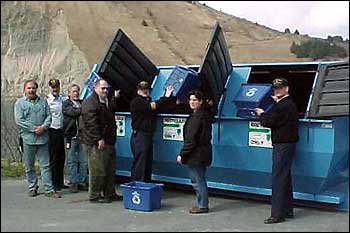 |
In 2001, recycling at the Coast Guard's
Kodiak, Alaska, facility included more than 125,000 pounds of corrugated
cardboard, 41,000 pounds of office paper, and 1,500 pounds of aluminum
cans - as well as used oil, batteries, and lighting.
|
Case Study: Navy Whidbey Recycle Program
Recycling efforts take place everyday in every Federal facility across
the country. One such facility is the Naval Air Station on Whidbey Island
in Washington. Since 1990, the Navy Whidbey Recycle Program has grown
from recycling just 4% of its total waste in 1990, to 64% in 2001. Through
the use of an in-vessel composting system, the facility composts bio-solids
like waxed cardboard boxes, shredded paper, and food scraps. This helps
save the base over $565,000 every year.
The Base has also introduced programs for recycling water and hazardous
materials. Public drop-off facilities and weekly kerbside collections
also help to encourage and expand the recycling effort while disposing
of hazardous waste properly and safely. These recycling efforts have
more than tripled the amount of solid waste being recycled on the island.
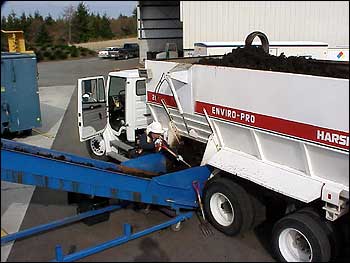 |
One of the Station’s trucks used to transport
biodegradable materials for recycling |
|